





 Local Weather
 Weather Forecast
 Weather Warnings
 Weather for Fishermen
 Weather for Marine
 Weather for Aviation
 Weather Monitoring Imagery
 GIS Weather Service
 Tropical Cyclone
 China Weather
 World Weather
 Climate Information Service
 Warnings & Signals Database
 Statistics of Special Weather Events
 Monthly Weather Summary
 Climate Change
 El Nino and La Nina
 Earthquakes
 Tsunamis
 Tide
Tide Geomagnetism
 Space Weather
 Weather Information for Astronomical Observation
 Interactive Sun Path Diagram
 Astronomical Data
 Interesting Astronomical Phenomena
 Time Services
 Calendar
 Almanac
 Real time Radiation level in Hong Kong
 Understanding Radiation
 Radiation Monitoring, Assessment and Protection
 Environmental Radiation Monitoring Programme
 Daya Bay Contingency Plan
 Related Sites
 Schools
 Travel
 Sports
 Outdoor Photography
 CWOS
CWOS Senior Citizens
 Stargazers
 FoOb
FoOb My Little Observatory
 Interactive Map of Storm Damage by Mangkhut
 Educational Resources
 360 Tour of HKO
 Decoding Radiation
 A Tour of Tropical Cyclones
 Cloud Appreciation by Dr Tin
 International Cloud Atlas
 Guided Tour
 Courses and Activities for the Public
 Subscription of e-Bulletins
 Research Forum
 Publications
 International Atomic Energy Agency
 Regional Specialized Meteorological Centre for nowcasting
 Asian Aviation Meteorological Center
 Social Media
 Press Releases
 What's New
 HKO Updates
 LegCo Questions and Answers
 Weather Chit Chat
 Observatory's Blog
 Weather On-Air
 Cool Met Stuff
 Central Briefing
 Tropical Cyclone Report Broadcast
 Observatory's News
 Vacancies
 Tender Notices
 Apps
Apps Personalized Website
 Weather Wizard
 Weather Information in Text
 Weather Information in RSS
 Audio Web Page
 Forms
Forms Open Data
 HKO Corporate Video
 Vision and Mission
 Organizational Structure
 Quality Management
 Hong Kong Observatory – The Facts
 Hong Kong Observatory 2024
 Our Services
 Programme Areas of the Observatory
 History of the Hong Kong Observatory
 Career@HKO
 Visitors Figures
 Hong Kong Observatory Open Day 2025


What is "Heatwave"?
What is "Heatwave"?
CHONG Man-lok, KONG Wai
October 2021
Under global warming, extreme weather events, such as extreme high temperatures, have become more frequently. From time to time, we learned from the media that a region was hit by "heatwave" with record-breaking temperatures. So, what is "heatwave"? How does "heatwave" bring abnormal hot weather?
"Heat" in the first part of the word "heatwave" refers to temperatures higher than the climatological normal of an area. When those anomalous high temperatures sustain for a certain period of time, the situation will be named as "Heatwave". As the characteristics of climate vary place by place, there is no universal definition of "heatwave" in terms of the degrees of temperature above the climatological normal and the duration.
Some may have mistaken heatwave as a weather system, being the "cause" of persistent and abnormal hot weather. Indeed, heatwave is a phenomenon, and it does not "hit" or "depart" from a place like a weather system. Its spread and persistence depend on the weather systems that give rise to the heatwave. In other words, heatwave is the "effect" instead of the "cause" of persistent and abnormal hot weather. For example, heatwaves over mid to high-latitude regions are usually caused by blocking[1]. Under blocking pattern, the atmospheric circulation becomes relatively stagnant. Subsiding air of the ridge of high pressure inhibits cooling. Together with hot air mass being transported from low latitudes to mid and high latitudes, such pattern is conducive to sustained hot weather in summer.
The heatwave that started affecting the northwestern part of North America in late June 2021 was in fact a result of blocking. Figure 1 shows temperatures over some places in the northwestern part of the United States and the southwestern part of Canada were more than 10 degrees above the climatological normal. Lytton, a village located in the southern part of British Columbia, Canada, even recorded a record-breaking temperature of 49.6 ℃, which was also the highest ever observed in Canada[2].
Prolonged exposure to high temperatures will cause heat exhaustion, as well as deterioration of health conditions of some patients with chronic diseases[3], leading to fatalities. Over 10,000 deaths were attributed to the heatwave over Russia in July 2010[4]. Besides, increase of electricity demand over cities and possibility of crop failure are also some socio-economic impacts of heatwaves.
Researches revealed that heatwaves are very likely to occur with higher frequency and longer duration under global warming[5]. We must take every effective measure now to save energy and reduce emissions, in an effort to slowing down global warming, and to adapt to climate change and combat against extreme weather. Otherwise, mankind will face the unbearable consequences.
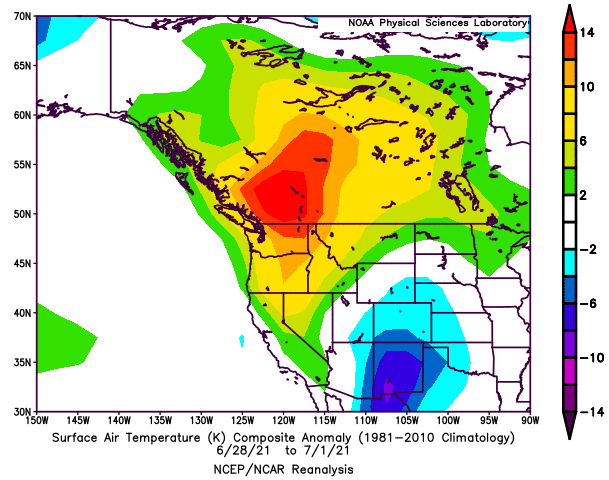
Figure 1: Temperature anomalies over North America in late June to early July 2021. Temperatures above 10 degrees of the climatological normal are represented by orange and red colours. (Source: This link will open in a new windowNational Oceanic and Atmospheric Administration of the United States)
References:
[1] Cool Met Stuff: This link will open in a new windowOmega Blocks (in Chinese only)
[2] Royal Meteorological Society: This link will open in a new window Record-breaking heat in Canada
[3] World Meteorological Organization: This link will open in a new windowHeatwaves and Health: Guidance on Warning-System Development
[4] Hong Kong Observatory: Extreme weather events
[5] The Fifth Assessment Report of the Intergovernmental Panel on Climate Change: This link will open in a new windowThe Synthesis Report, SPM2.2
[1] Cool Met Stuff: This link will open in a new windowOmega Blocks (in Chinese only)
[2] Royal Meteorological Society: This link will open in a new window Record-breaking heat in Canada
[3] World Meteorological Organization: This link will open in a new windowHeatwaves and Health: Guidance on Warning-System Development
[4] Hong Kong Observatory: Extreme weather events
[5] The Fifth Assessment Report of the Intergovernmental Panel on Climate Change: This link will open in a new windowThe Synthesis Report, SPM2.2